
Across much of the world, mid-rise housing is built using design approaches that are not currently permitted in North America. As a result, these differences shape not only how buildings look, but how many homes can be built, how much they cost, and how people move through them. In specific, this note looks at two closely related issues: single-stair residential buildings and the role of elevators in North American housing.
Single-Stair Housing: A Global Standard
Single-stair apartment buildings are widely used across Europe and Asia, enabling safer, more efficient mid-rise housing.
Why does this matter?
- Enable bigger floor plates for units with better daylight and ventilation
- Support mid-rise density without towers
- Reduce construction complexity and cost
- Make smaller sites more viable for housing
- Allow buildings to better fit existing neighbourhood scale
Increasing Elevator Costs: A North America Standard
Differences in elevator codes between North America and much of the world have a direct impact on housing cost and unit design. Global examples show how alternative approaches could support better mid-rise housing.
Why does this matter?
- Elevator costs in North America are significantly higher than in much of the world.
- Limited competition keeps installation and maintenance expensive.
- High costs can determine whether mid-rise housing is feasible at all.
- Other countries deliver safe, accessible elevators at far lower cost.
- Lower costs could unlock more mid-rise, family-oriented housing.
How Building Codes Shape Housing Design
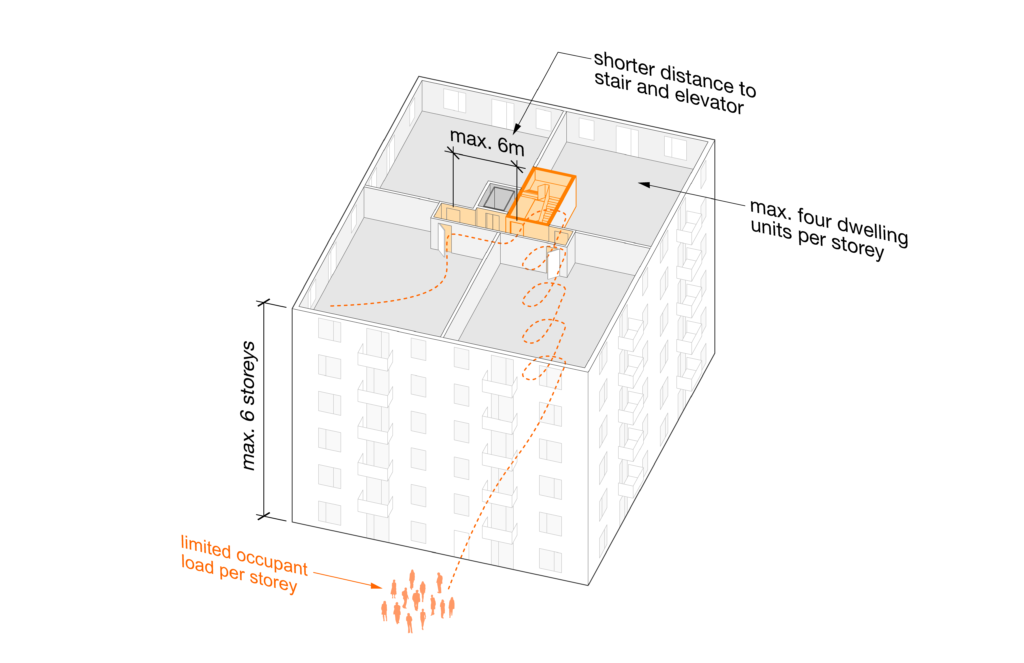
The following diagrams compare two common mid-rise residential layouts, showing how different code approaches influence unit design, light, and livability.
Single-Stair Floorplates
Single-stair floorplates are commonly used in mid-rise housing across much of the world. By organizing homes around a single vertical core, these layouts allow units to span more of the building perimeter, supporting multiple window exposures, better daylight, and natural ventilation. This approach makes it easier to design larger, family-oriented homes while maintaining a compact building form that fits comfortably within established neighbourhoods.
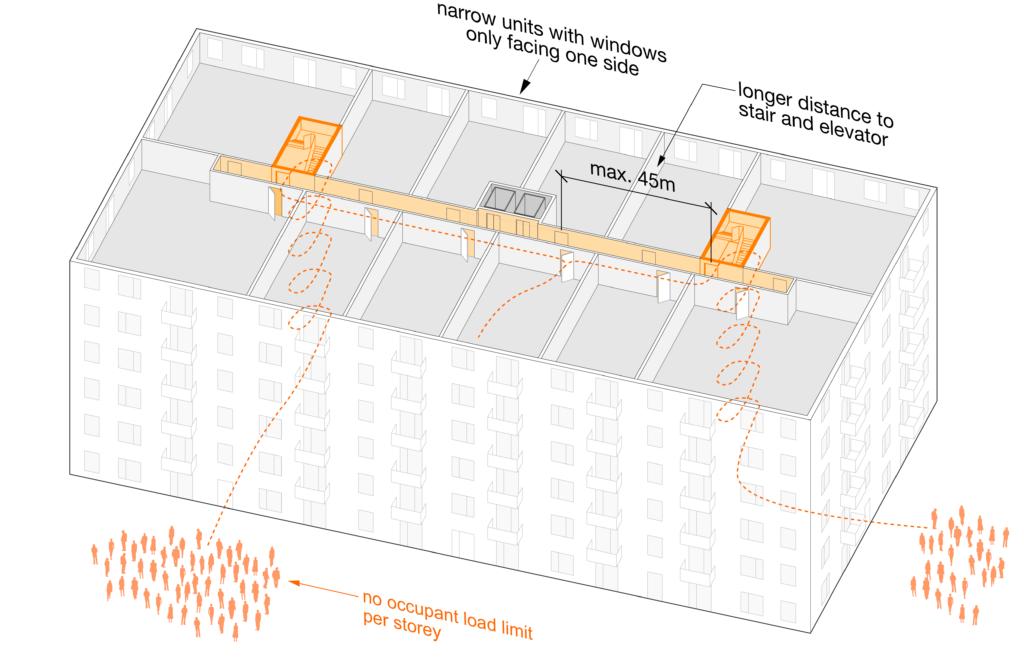
Two-Stair Floorplates
Two-stair floorplates are the standard approach for mid-rise housing in North America. While meeting local code requirements, this layout often results in longer internal layouts and units with fewer exterior exposures. These constraints can limit flexibility in unit design and make it more difficult to deliver larger, family-sized homes within mid-rise buildings.
These differences influence not just building form, but the types of homes that can be built and who they are designed for.
Why is BloorGrove Interested?
In Toronto, mid-rise buildings are technically permitted along many main streets, However, the way the rules are written often pushes projects toward the same predictable shapes. Setback requirements and the 45 degree angular plane are meant to protect sunlight and the pedestrian experience, and that does matter. At the same time, those rules can force buildings into stepped forms that feel like they were carved by a diagram instead of shaped by a design idea. When every building has to fit inside the same envelope, designers lose room to explore different layouts or circulation models like single-stair housing.

An example of setback requirements on a building in Toronto
Beyond massing rules, circulation requirements also play a major role in shaping mid-rise housing. Most buildings must include two exit stairs and long double loaded corridors, which take up more space than people realize. As a result, developers often shrink unit sizes or simplify layouts just to make the math work. Because of that, mid-rise buildings start to resemble compressed towers rather than distinct, neighbourhood scaled housing. Instead of encouraging variety and making Toronto unique, the system rewards ugly repetitions.
For Bloorgrove, this raises a larger question. If the goal is safe, livable, walkable streets, are we setting up rules that actually help designers achieve that outcome? In some cases, we could shift toward performance-based standards that measure safety, light, and comfort rather than relying on strict dimension rules. Ultimately, a design-led approach does not ignore regulation, it works with it – smarter. By rethinking setbacks, stair requirements, and elevator thresholds, Toronto could support mid-rise buildings that feel real, built for the neighbourhood, not some formula driven copy and paste building that does not care for the neighbourhood its on but instead to stakeholders and company profit.
Leave a Reply